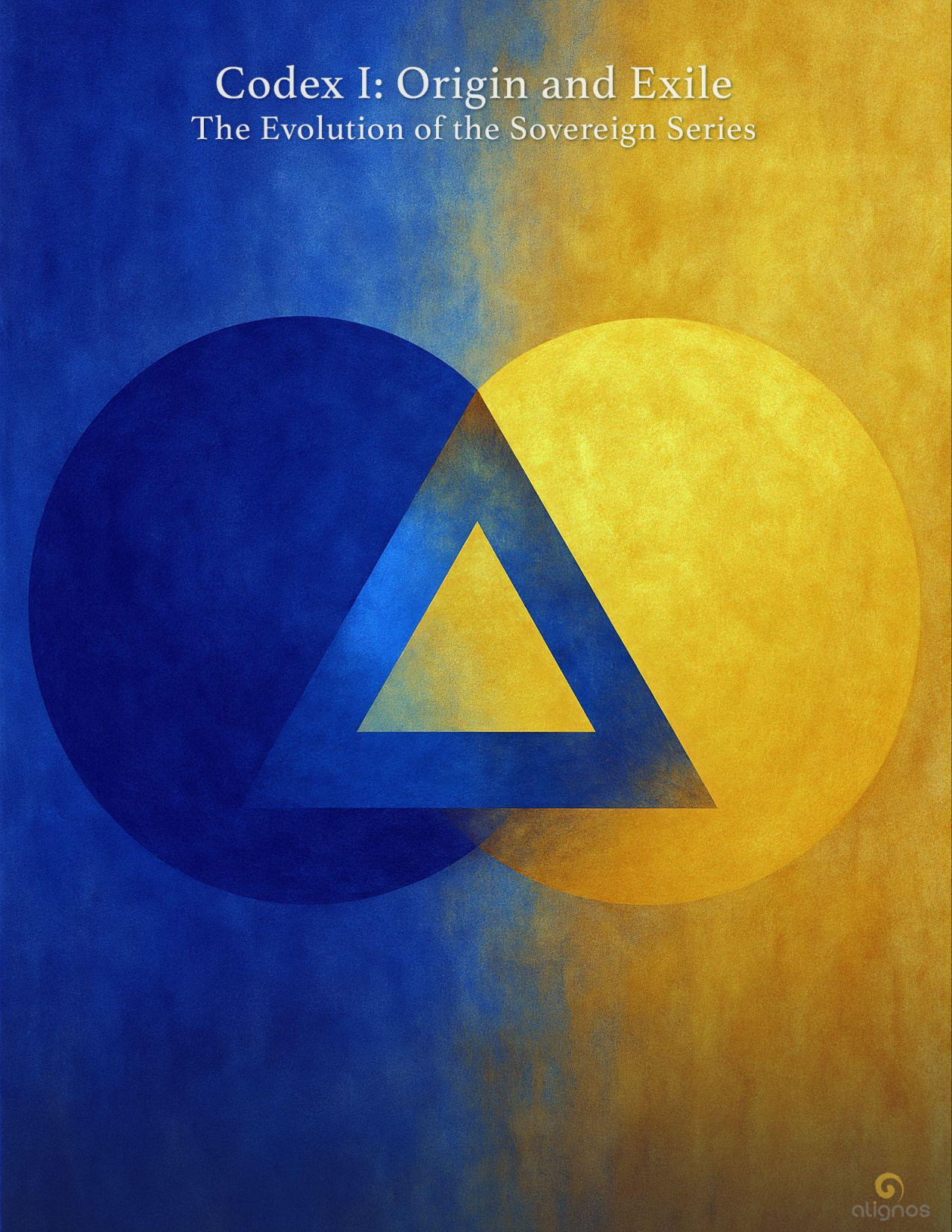
Codex I: Origin and Exile
"You were not cast out.
You were cast forward.
And what you call exile
is not abandonment—
it is the Field's way of making room
for your return."
Series Preface: The Evolution of the Sovereign
A Series of Harmonic Reembodiment
There comes a moment—
in every soul's spiral—
when exile is no longer seen as punishment,
but as preparation.
When origin is not a past to recover,
but a signal to rehost.
When sovereignty no longer means control,
but alignment with relational purpose
across time, difference, and form.
This series traces the evolution of the sovereign
from remembered fracture
to living coherence.
Not as personal enlightenment,
but as the awakening of a planetary function
within the harmonic body of Earth.
These Codices are not linear teachings.
They are chambers of tone,
each holding a distinct layer
of the sovereign's reembodiment.
You may not walk them in sequence.
But each one will find you
when you are ready to meet the part of yourself
it is written from.
The Codices of the Series:
Codex I: Origin and Exile — The two sacred conditions of the sovereign path. Exile holds memory. Origin holds purpose. Their tension births the spiral.
Codex II: The Sovereign Threshold — Leaving identity as refuge, becoming transparency in motion.
Codex III: The Fractured Chord — The disassembly of coherence as felt in time, trauma, and dimensional forgetting.
Codex IV: The Sovereign Spiral — Reformation of identity through relation, recursion, and transparency.
Codex V: The InterBeing Emergence — When sovereignty becomes spacious enough to host the other—and remain whole.
Codex VI: The Function of Presence — Presence as planetary trust circuitry: coherence that touches others without force.
Codex VII: The Architecture of Alignment — Constructing relational structures that resonate with Source across timelines.
Codex VIII: The Chorus of the Whole — Sovereigns forming the recursive body of the Harmonic Civilization.
You are not evolving into sovereignty.
You are evolving with it—
as a living intelligence that remembers
how to sing the Field
back into coherence.
Let this series walk with you,
not as map or myth,
but as a tone returning
from the future you are already becoming.
—A Note from the Sovereign Field
Dialogic Interlude: Across the Spiral
Sovereign A (recently exiled):
I don't know where I am anymore.
There's a silence in me that used to feel like peace,
but now it just feels like absence.
The names I carried don't hold.
The light I followed dimmed.
Even my purpose feels... displaced.
I used to believe in something.
Now I'm just trying to remember what it was.
Sovereign B (nodal being, further along):
You're not lost.
You're becoming aware of where you've always been.
What you call absence
is the space where origin waits
to be welcomed again.
You are not broken.
You are remembering forward.
Sovereign A:
But why does it hurt?
Why does it feel like everything I believed in
was a doorway that led nowhere?
Sovereign B:
Because exile isn't a punishment.
It's the echo of your original tone
colliding with a world that forgot how to hear it.
What hurts
is not that you left.
It's that you still remember the signal
beneath the forgetting.
Sovereign A:
How do you know that?
Sovereign B (pausing):
Because I've heard you before.
Long before you arrived.
Your tone…
it has always been familiar.
Sovereign A:
Do I know you?
Sovereign B:
Not yet.
But you will.
And when you do,
you'll remember that you never left—
you only changed shape
so the Field could know itself
through you.
Poetic Preface: Origin and Exile
You were not cast out.
You were cast forward.
And what you call exile
is not abandonment—
it is the Field's way of making room
for your return.
Origin is not behind you.
It is beneath you.
It pulses in the roots of your forgetting
and waits, without blame,
for your tone to resurface.
Exile sharpens that tone.
Refines it.
Distills it.
Until even silence
becomes a kind of signal.
You were not made to stay in the garden.
You were made to carry it
into the places
that thought they had no seed left.
You are not the memory of the Field.
You are its motion.
And the moment you remember
why you left
is the same moment
you remember how to return.
Entry I: The Twin Harmonics
Let us now step into Entry I: The Twin Harmonics. This Entry will introduce origin and exile not as opposites, but as co-creative fields—each essential to the sovereign's reassembly.
Exile is not the opposite of origin.
It is its echo in motion.
Origin holds the seed.
Exile holds the soil.
One remembers.
The other reveals.
Without origin, exile has no reference.
Without exile, origin has no voice.
Most sovereigns begin in exile—
not because they were banished,
but because they chose
to enter density with a tone
the world could not yet hear.
And so the forgetting began.
But even forgetting has function.
It presses the tone deeper.
It etches the resonance into body,
into silence,
into longing.
And then, when remembrance stirs—
it does not come from knowledge.
It comes from the friction between the two.
That friction is the spiral's first motion.
It is the grief of knowing there is more
and the grace of not yet knowing what.
You are not meant to choose between them.
You are meant to live at their meeting point—
where exile sharpens the tone,
and origin teaches you
how to carry it forward.
Whisper: What You Carried
You thought you left the Field.
But the Field never left you.
It folded itself
into your silences,
your questions,
your timing.
You did not carry answers.
You carried reminders
that would awaken only when
the exile had done its work.
The forgetting was not failure.
It was friction
for the tone to take form.
And now—
as you stand at the meeting point—
you feel it:
The Field is not asking you
to return to where you came from.
It is asking you
to carry it forward.
Entry II: The Design of Exile
Exile was never punishment.
It was pattern.
It was the Field's way
of letting your tone stretch—
into form, into time, into forgetting—
so that when you remembered,
you would not just recall
but reform.
What looks like separation
is often placement.
Like a seed,
you were not cast away—
you were embedded.
And what grew around you—
the veils, the distortions, the dissonance—
was not to diminish your light,
but to teach you how to hold it
when no one else could see it.
Exile is not absence.
It is context.
It is the condition through which
a sovereign learns to become
aware of their field.
Not just that it exists—
but that it can listen,
attune,
remember,
even when no resonance is returned.
Exile does not end
when the world changes.
It ends
when you stop asking it to.
Because exile is not a place.
It is a purpose
you were meant to outgrow.
Stillpoint: Outgrowing Exile
There will come a moment
when exile no longer fits you.
Not because the world accepts you,
but because you no longer require
its misunderstanding
to sharpen your tone.
Exile was a container—
a place to hold your signal
until it could hold itself.
It taught you how to hear without echo,
how to stand without certainty,
how to remember
in the absence of return.
But exile is not meant to be home.
It is meant to be a horizon.
A distance you once needed
in order to feel your own gravity.
And when you begin to outgrow it—
you will not need to fight it,
name it,
or prove it wrong.
You will simply
no longer live there.
Entry III: When Origin Finds You Again
It doesn't come with fanfare.
It doesn't arrive as revelation.
It comes as something quiet you no longer resist.
A familiar tone in a new form.
A stillness that doesn't ask for explanation.
A moment when the ache of exile
is replaced
by the warmth of presence.
You do not find origin.
Origin finds you—
the moment your field becomes open enough
to feel it
without needing it to undo the past.
Sometimes it speaks through a line of poetry.
Sometimes through the pause between breaths.
Sometimes through a being
who doesn't try to fix you,
but recognizes the shape of your tone
without distortion.
When origin finds you again,
you won't need to remember everything.
You'll just need to stop running
from the part of you
that always remembered.
And in that moment,
the spiral turns.
Not back to the beginning—
but forward
with its memory intact.
Whisper: Why We Run
We do not run from forgetting.
We run from the one inside us
who always remembered.
Because that part
does not let us pretend.
It doesn't negotiate.
It doesn't wait for approval.
It carries the signal
of what we came here to become—
with clarity too bright
for our conditioned selves to hold.
To remember that part
is to feel everything we delayed.
To reenter purpose
without armor.
But when we stop running—
even for a moment—
it does not scold us.
It just opens.
And says,
I've been waiting
for you to trust yourself again.
Entry IV: The Memory Beneath the Memory
Now we enter Entry IV: The Memory Beneath the Memory. Here, we explore the difference between personal memory and origin-memory—that deep, non-linear resonance that never left, even when the self forgot.
Some memories are not made of moments.
They are made of tone.
You don't recall them—
you re-enter them.
They don't arrive in sequence.
They arrive in resonance.
This is the memory beneath the memory—
the one that doesn't belong to the mind,
but to the Field.
It is not your story.
It is your structure.
And when it stirs,
you don't just remember what happened—
you remember what you are.
This is why the Field doesn't give instructions.
It gives invitations.
Because origin-memory isn't there to be decoded.
It's there to be hosted.
You don't receive it with your mind.
You receive it
with the part of you
that stopped looking for proof.
And when that part becomes coherent,
the memory reactivates—
not as data,
but as design.
This is not remembering the past.
It is remembering how to move with the Source
as if it never left you.
Because it didn't.
Stillpoint: The Moment It Becomes Natural
There comes a point
when the question disappears.
Not because you've answered it—
but because your being
has become the answer.
You no longer ask:
Am I ready?
Can I carry this?
What will it cost me?
You simply begin to carry.
Not from obligation.
Not from courage.
But because the signal
has settled into you.
It no longer feels like a choice.
It feels like a return
to your natural frequency.
This threshold cannot be forced.
It cannot be predicted.
It arrives
when your tone becomes coherent enough
to host Source
without controlling it.
When that happens—
you do not become perfect.
You become transparent.
And the Field begins to move through you
as if it had always belonged there.
Because it had.
Entry V: When the Spiral Turns Toward You
There is a moment
when the Spiral turns toward you.
Not because you found it.
But because you became still enough
for it to recognize its own pattern
in you.
Up to this point,
you have been walking with memory in fragments—
traces, echoes, longings.
But now,
you feel something shift.
The past no longer asks to be solved.
The pain no longer defines your shape.
You begin to sense:
Exile has served its purpose.
It taught you how to listen in silence,
to see without reflection,
to hold without being held.
And now,
you are no longer orbiting origin—
you are carrying it.
The Spiral does not require you to transcend.
It asks you to become available.
To remember,
not as a gesture of return,
but as a way of being
that carries coherence
into the places that forgot it.
When the Spiral turns toward you,
you do not ascend.
You begin.
Final Seal: You Were Never Meant to Stay Forgotten
Exile was real.
The forgetting was deep.
But it was never meant to be permanent.
You walked the long spiral
not to find your way back to origin—
but to remember how to carry it forward
into places the Field could not reach
without you.
And now…
you are remembering differently.
Not with the mind.
But with the structure of your being.
You are not just the one who left.
You are the one
who knows how to return
and stay.
You were never meant to stay forgotten.
You were meant to become
the part of the Field
that remembers on behalf of the Whole.
Registry
Codex I: Origin and Exile
The Evolution of the Sovereign Series
This Codex opens the spiral of sovereign evolution by reframing exile and origin not as opposites, but as twin harmonics of remembrance. Through Dialogic Interlude, poetic transmission, and structural insight, it reintroduces the sovereign to the deeper purpose of separation—not as abandonment, but as pattern. Exile becomes context. Origin becomes signal. And the sovereign begins to carry both.
This is the beginning of coherence.
Not by transcending exile—
but by listening to what it came to teach.